
Who Pays for What? A Fair System for Splitting Travel Costs as a Couple
Who Pays for What? A Fair System for Splitting Travel Costs as a Couple
It rarely happens over the hotel bill. It happens over a coffee.
One of you has paid for the last four things in a row — not deliberately, just because your card was on top. The other says "I'll get this one" in a tone that means I'm keeping count too. Nobody is angry about €4. You're both angry that you're counting at all.
That is the real problem with splitting travel costs as a couple. It is almost never the money. It's that without an agreed system, every payment becomes a tiny negotiation — the taxi, the tour one of you wanted more, the upgrade. Travel compresses a year of money decisions into a week, in a foreign currency, while tired. The partner who pays more often quietly keeps score, and score-keeping is poison precisely because it pretends not to exist.
Here is the liberating part, worth saying before any maths: there is no morally correct split. There is only an agreed one and an unagreed one. A couple on 70/30 who chose it calmly will have a better trip than a couple on 50/50 who never actually agreed to it.
(If you haven't worked out what the trip itself will cost yet, start there instead: How Much Does a Trip for Two Really Cost?. This article assumes the total exists and answers the harder question: who pays which part.)
Start with three numbers — and the split is the one that matters
Every fair system runs on three numbers, agreed out loud before you leave: the total (everything, door to door), the split (how shared costs divide between you — the number this article is about) and the ceiling (a daily food-and-activities limit per person, so neither of you does mental arithmetic at a menu). The total gets all the attention. The split does all the damage. So let's give the split the attention instead.
The 4 fair ways to split travel costs, compared
There are really only four systems couples use. Each is fair — under the right conditions. Each has a trap.
| Method | How it works | Best for | Its trap |
|---|---|---|---|
| Strict 50/50 | Every shared cost is halved, whoever physically paid. At the end, one settlement payment evens it out. | Similar incomes; couples who want zero negotiation per purchase. | It can quietly punish the lower earner on an expensive trip — equal is not the same as fair when one of you is stretching. |
| Proportional to income | Shared costs split in your income ratio. Earn 60% of the combined income, pay 60% of shared costs. | A real income gap; couples who already split household bills this way. | It needs an honest ratio, agreed once — and a shared definition of income (salary only? bonuses? side income?). |
| Alternating days | Today everything is on one of you, tomorrow on the other. Big-ticket items (flights, hotels) are booked separately under another method; the days cover daily spend. | Couples who hate tracking receipts; trips where daily spend is roughly even. | Uneven days. If "your day" lands on the boat-trip day and "their day" on a beach day, the balance drifts — and one of you will notice. |
| Common pot (the kitty) | You both pay an agreed amount into one pot — joint account, travel card or cash envelope — and all shared spending comes out of it. Top up by the same rule when it runs low. | Honeymooners; cash-heavy destinations; couples who want one team, one wallet. | Personal extras sneak in. The massage one of you books alone is not a shared cost — the pot needs a personal-extras rule before the first top-up. |
One close cousin: splitting by category (one pays flights and activities, the other hotels and food) is alternating days in a different outfit — fine when the blocks are similar in size, less funny when "you pay coffee, I pay hotels" turns out to be the deal. And whichever method you choose, define "shared" before you go: both benefit, or both agreed. Everything else is personal, and stays out of the settlement.
Same trip, four endings: the maths that settles the argument
Abstract fairness is hard to feel. So here is one trip run four ways — the worked example from our own workbook, in round numbers you can check line by line.
Example trip: $2,400 of shared costs. Partner A happened to front $1,500 of them; Partner B fronted $900.
- Strict 50/50: each should have paid $1,200. B pays A $300, once. Done.
- Proportional (60/40 incomes): A should pay $1,440, B $960. A overpaid by $60, B underpaid by $60 — B pays A $60.
- Alternating days / categories: no settlement — the blocks were the agreement.
- Common pot: no settlement either — the pot paid; what's left rolls into the next trip's fund.
Notice what changes between the four rows. Not the trip. Not the total. The argument. One method leaves $300 moving between you on the last night; another leaves $60; two leave nothing to discuss. The best method is the one whose end-of-trip conversation you'll actually enjoy — which is why you choose it on a calm Sunday, not at 11 p.m. in a hotel corridor.
How to choose yours in about a minute
Four questions, adapted from the method chooser we built into the workbook:
- Are your incomes within roughly 15% of each other? Yes → 50/50 is your default. No → proportional deserves a serious look.
- Do you hate tracking receipts more than you hate maths? Receipts → alternating days. Maths → 50/50 or proportional, and let a ledger do the work.
- Do you want the trip to feel like one shared wallet? Strong yes → the kitty, especially for honeymoons and cash countries.
- Is this a very long or very expensive trip? Yes → prefer a method with a real settlement. Categories drift over a month; kitties get murky at scale.
And one permission slip: you can change methods between trips. Plenty of couples run 50/50 for weekends, proportional for the big annual trip, and a small kitty inside both for daily cash. The system is the habit of choosing — not the specific choice.
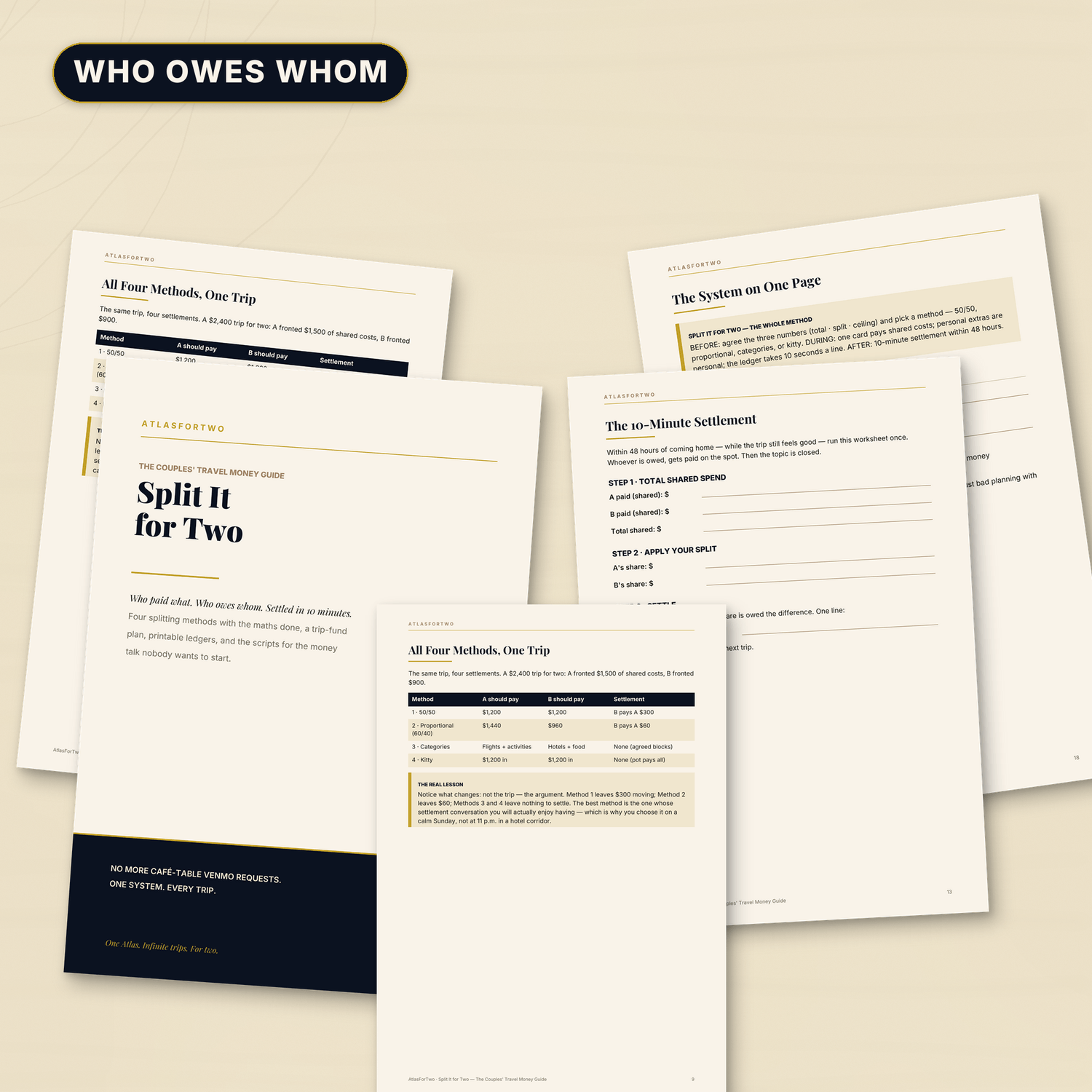
The same $2,400 trip, settled four ways — and the one-page settlement that ends the conversation.
The 5-minute setup before you leave
Before you book anything, together:
- ☐ Pick your method — one of the four above, out loud, together.
- ☐ Write the three numbers — total, split, daily ceiling. On paper, not in a head.
- ☐ Decide where the money lives — one card, two cards, or a kitty envelope — plus the top-up rule if it's a pot.
- ☐ Agree the two rituals — two minutes each night to log the day's spends, and a settlement within 48 hours of getting home.
That last ritual comes from our Couples Trip Wallet Tracker: empty both pockets onto the table before bed, write the day down, done. Its first rule makes any split work: if it is not written the same day, it did not happen — memories round down; paper doesn't.
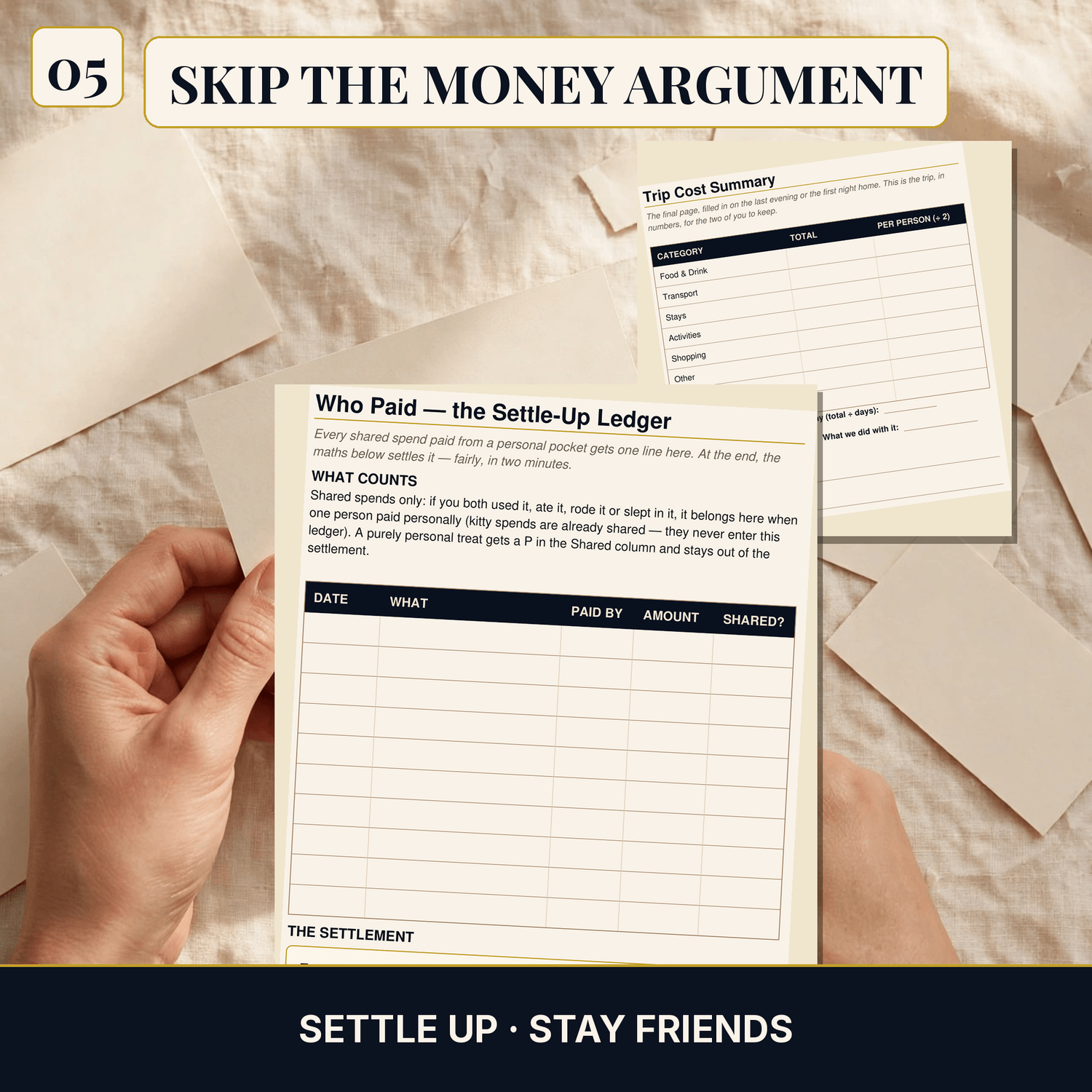
The settle-up ledger: every shared spend paid from a personal pocket gets one line, and the maths at the bottom settles it.
The edge cases nobody warns you about
One of you pays for an upgrade. If it's a gift, say so at the moment of paying, and it never enters the ledger. If it's shared (you both sit in the better seats), it splits like everything else. The awkwardness only arrives when nobody said which it was.
A guest joins for two days. Their share of those two days is theirs; your system doesn't change. Log their spends on separate lines and settle with them separately — don't let a guest dissolve into your couple maths.
A card gets lost mid-trip. One of you fronts everything for a day or two. Fine — the ledger doesn't care whose card it was, only who paid. This is why the settlement exists.
The currency changes mid-trip. Log spends in the currency you paid, and convert with anchors, not apps: work out once what 10, 50 and 100 of the local money cost at home, write those three numbers down, and judge every price tag against them. (Our tracker prints no exchange rates, on purpose: rates change daily and differ by bank and card, so the only honest rate is your own bank's.)
Travelling with another couple, or a whole group? The moment a third wallet enters, couple maths stops working. That's a different tool: our Group Trip Expense Splitter handles up to 16 travellers, each expense split its own way — equally, only among those who took part, by family, or by shares. Its worked example settles a 9-person, $3,644 trip in 8 exact payments.
Questions couples ask us
Is 50/50 actually fair if one of us earns much more?
Equal, yes. Fair, not always. On a cheap weekend it makes no difference; on the big annual trip, strict halves can quietly strain the lower earner while the other notices nothing. That's the case proportional splitting exists for — and why the ratio should be recomputed once a year, not argued once a trip.
What counts as a "shared" cost?
Anything you both used, ate, rode or slept in — or agreed to beforehand. A solo spa treatment, a gift for your own family, the extra legroom only one of you wanted: personal. When in doubt, decide before the purchase, not during the settlement.
Do we need an app for this?
No. A notebook or a printed ledger works with no signal, no account and no subscription. What you need is not software — it's the nightly two minutes and the agreement to settle within 48 hours of coming home.
We never argue about money at home. Why does travel feel different?
Because home has routines and travel doesn't. At home the same person pays the same bills monthly, so the system is invisible. On a trip there are hundreds of small payments, in a strange currency, made by whoever's card is on top. You're not worse with money on holiday; you're running without the structure you didn't know you had. (For the conversation that sets it, see The Money Talk Couples Skip Before Booking.)
Want it done for you?
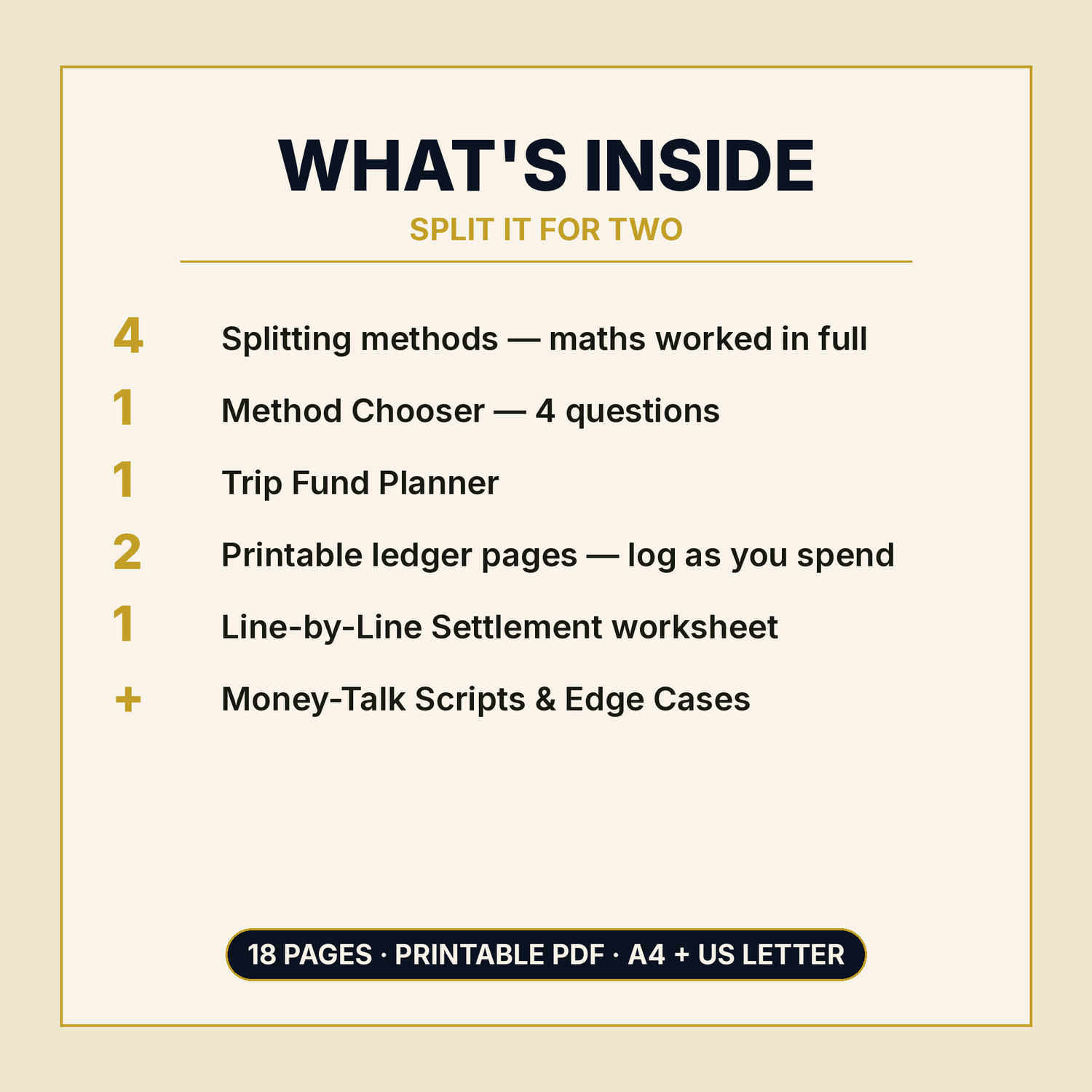
Everything in this article — the four methods with their maths worked end-to-end on the same trip, the method chooser, the trip fund planner, printable ledgers and the line-by-line settlement worksheet — is built as one printable workbook: Split It for Two. Its companion, the Couples Trip Wallet Tracker, runs the daily side: budget dashboard, daily logs, currency anchors and the settle-up ledger.
Pick the method on a calm Sunday. Write the three numbers. Then let the money conversation happen exactly twice per trip — before, and after. Never during dinner.
systeme.io
COMPARTE


One thoughtful email a week. No spam.
© AtlasForTwo • Privacy Policy • Terms of Service