
The Pre-Trip Agreement: 12 Conversations to Have Before You Book Anything
The Pre-Trip Agreement: 12 Conversations to Have Before You Book Anything
Most couples plan a trip in the wrong order. First the flights, then the hotel, then the excited screenshot to the family group chat — and somewhere around Day 3 they discover they were never actually planning the same holiday.
One of them pictured slow mornings. The other booked a 6 a.m. hike. Neither is wrong. They just never said it out loud.
That's the quiet truth about travel fights: most of them aren't about the trip at all. They're about things nobody said before booking — and every one of those disagreements is far cheaper at your kitchen table than in another country, with non-refundable reservations attached. The fix isn't a longer itinerary. It's a shorter conversation, held earlier.
Here are the 12 conversations to have before any money moves. Together, they form a pre-trip agreement: not a legal document, not a romance killer — just the two of you, aligned on paper, before the booking sites get your card number.
How to use this list — the 20-minute setup
One coffee. Phones in another room. Before you book anything. Go through the 12 conversations in order, answer each one out loud, and wherever you disagree, write down the compromise — that writing-down part is the whole point. When you reach the end, you'll know things about how you travel together that no amount of "we'll figure it out" would ever have told you.
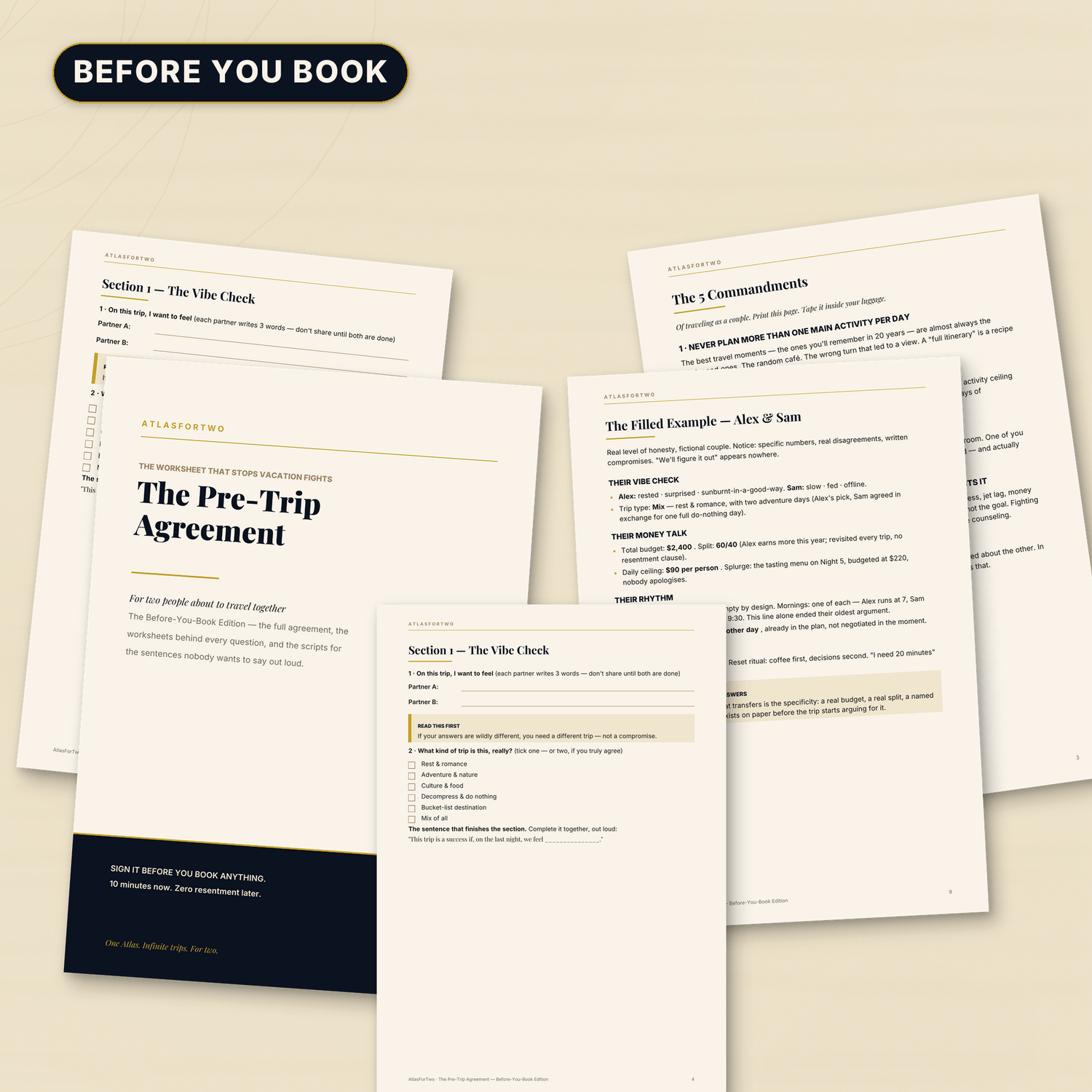
The agreement itself: five short sections, a filled example, and one rule — sign it before you book anything.
First, the vibe: what is this trip actually for?
Conversation 1 — The three words.
Ask each other: "On this trip, I want to feel…" — three words each, written separately, no peeking until both are done. Then finish this sentence together, out loud: "This trip is a success if, on the last night, we feel ___."
The agreement to close: both sets of words on paper, and the success sentence in one line. If your words are wildly different, you don't need a compromise — you need a different trip.
Conversation 2 — What kind of trip is this, really?
Ask: "If we could only pick one or two — rest & romance, adventure & nature, culture & food, decompress & do nothing, the bucket-list one — which is this?"
The agreement to close: one trip type (two, only if you truly agree). Every later decision gets easier once the trip knows what it is.
Money: three numbers, said out loud
Conversation 3 — The total.
Ask: "Door to door, everything included — what's the real number for this trip?" Not the flight price, not the hotel price: the whole thing, both of you combined.
The agreement to close: one total budget, written down, that both of you have actually said out loud. A number that only exists in one person's head is not a budget; it's a future argument.
Conversation 4 — The split.
Ask: "How are we dividing it — 50/50, 60/40, proportional to income, or one pays flights and the other pays hotels?" And the follow-up nobody asks: "How do we handle it during the trip itself?"
The agreement to close: a named split, plus a system: one card pays shared costs on the road, personal extras stay personal, and you settle up within 48 hours of coming home — while the trip still feels good.
Conversation 5 — The daily ceiling and the splurge.
Ask: "What's our food-and-activities ceiling, per person, per day?" And then the fun one: "What's our one planned splurge — the thing nobody has to apologise for?"
The agreement to close: a daily ceiling (it's not a punishment; it's the number that lets both of you order without doing mental maths at the table) and one splurge, named and budgeted in advance. Guilt-free, because it was agreed guilt-free.
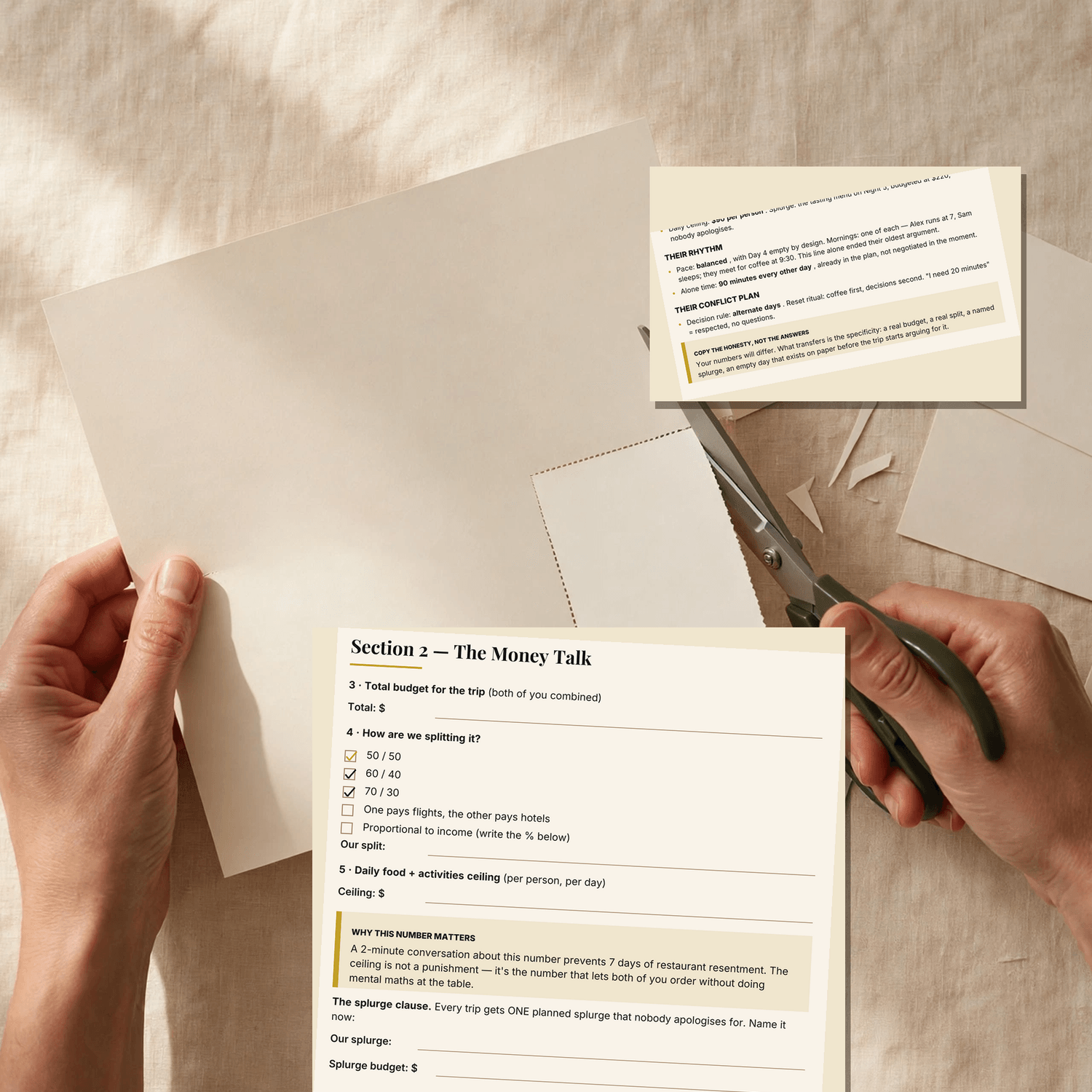
Section 2 of the agreement: total budget, the split, and the daily ceiling — the two-minute talk that prevents a week of restaurant resentment.
What "done" looks like. Inside the Pre-Trip Agreement we built at AtlasForTwo, a filled-in example couple — Alex & Sam — shows the level of honesty to copy: a $2,400 total budget, split 60/40 because Alex earns more this year, a $90-per-person daily ceiling, and the tasting menu on Night 5 budgeted at $220 as the splurge nobody apologises for. Your numbers will differ. The specificity is what transfers.
Pace & energy: how full is a day allowed to be?
Conversation 6 — The pace.
Ask: "Are we a one-main-activity-a-day couple, a balanced two-or-three, or a packed-schedule team — honestly?" And: "Where is our do-nothing day?"
The agreement to close: a pace you both picked, with at most one main activity anchoring each day and one day in the plan that is empty on purpose. The best travel moments are usually the unplanned ones — they can only happen if the plan leaves them room.
Conversation 7 — Mornings.
Ask: "Who's up early, who isn't — and what happens in the gap?" This sounds small. It is, empirically, where first trips together go to argue: one partner dressed and impatient at 7, the other asleep and resenting the alarm by proxy.
The agreement to close: a morning protocol. Both early, both slow, or one of each — in which case the early riser gets solo coffee or a run, guilt-free, and you meet at a set time. In the example above, that single line — Alex runs at 7, Sam sleeps, coffee together at 9:30 — ended a couple's oldest argument.
Space & screens: time apart, phones down
Conversation 8 — Alone time.
Ask: "How much time apart do we build in — and when, exactly?" Not whether: when. Seven days in a small hotel room is a lot of togetherness for any two humans.
The agreement to close: alone time scheduled, not just allowed — 90 minutes every other day is a good default. One of you reads at a café; the other visits the museum solo. You come back refreshed, and actually pleased to see each other.
Conversation 9 — The phone rules.
Ask: "When are phones down — at meals? After dinner? Is work email allowed on this trip at all?"
The agreement to close: one clear rule you'll both keep: phones down at meals, or one photo window per place and then pockets, or free use but no work email after dinner. Pick the version you can honour; an ambitious rule that collapses on Day 1 protects nothing.
Memories: what you're keeping — and what you're skipping
Conversation 10 — Photos, proof and the nightly three lines.
Ask: "Who's taking the photos — and how do we make sure neither of us is missing from all of them?" And: "What's the one thing we are NOT doing on this trip?"
The agreement to close: take turns behind the camera, ask a stranger for one photo of you both every day, and let the camera go away for one meal a day. Each night, two minutes: three lines each — best moment, funniest thing, one thing you learned about the other. And write down the thing you're relieved to skip; naming it kills the FOMO. (Honeymoon or anniversary? Add one line: a small surprise each, planned in secret.)
When things go wrong: decide the recovery before you need it
Conversation 11 — The decision rule.
Ask: "When we disagree about what to do — and we will — how do we decide?"
The agreement to close: one rule, chosen in peacetime: trade-offs (you pick restaurants, I pick hotels), vote and commit with no resentment afterwards, alternate days — or rock-paper-scissors for the small stuff. The rule matters less than having one.
Conversation 12 — The 20-minute rule and the reset.
Ask: "When one of us is overwhelmed, what do we do — exactly?"
The agreement to close: if either of you says "I need 20 minutes," the other respects it — no following, no "let's talk it out right now," emergencies excepted. And pick your reset ritual for a day that goes sideways: coffee before deciding anything, half an hour back at the room to re-plan, or ask "What would make tonight good?" — then do exactly that. Not fighting is not the goal; fighting badly is. Couples who recover in twenty minutes agreed on the recovery before they needed it.
The last step before you pay: the booking gate
When all 12 conversations are closed, run one final check — the agreement calls it the Booking Gate: budget written and said out loud, split and ceiling set, splurge named, pace picked, a do-nothing day in the plan, alone time scheduled, mornings agreed, decision rule and 20-minute rule in place. If any box is unticked, you're not ready to book. All ticked? Book the trip — and keep a photo of your answers with the confirmations. You'll want them on Day 3.
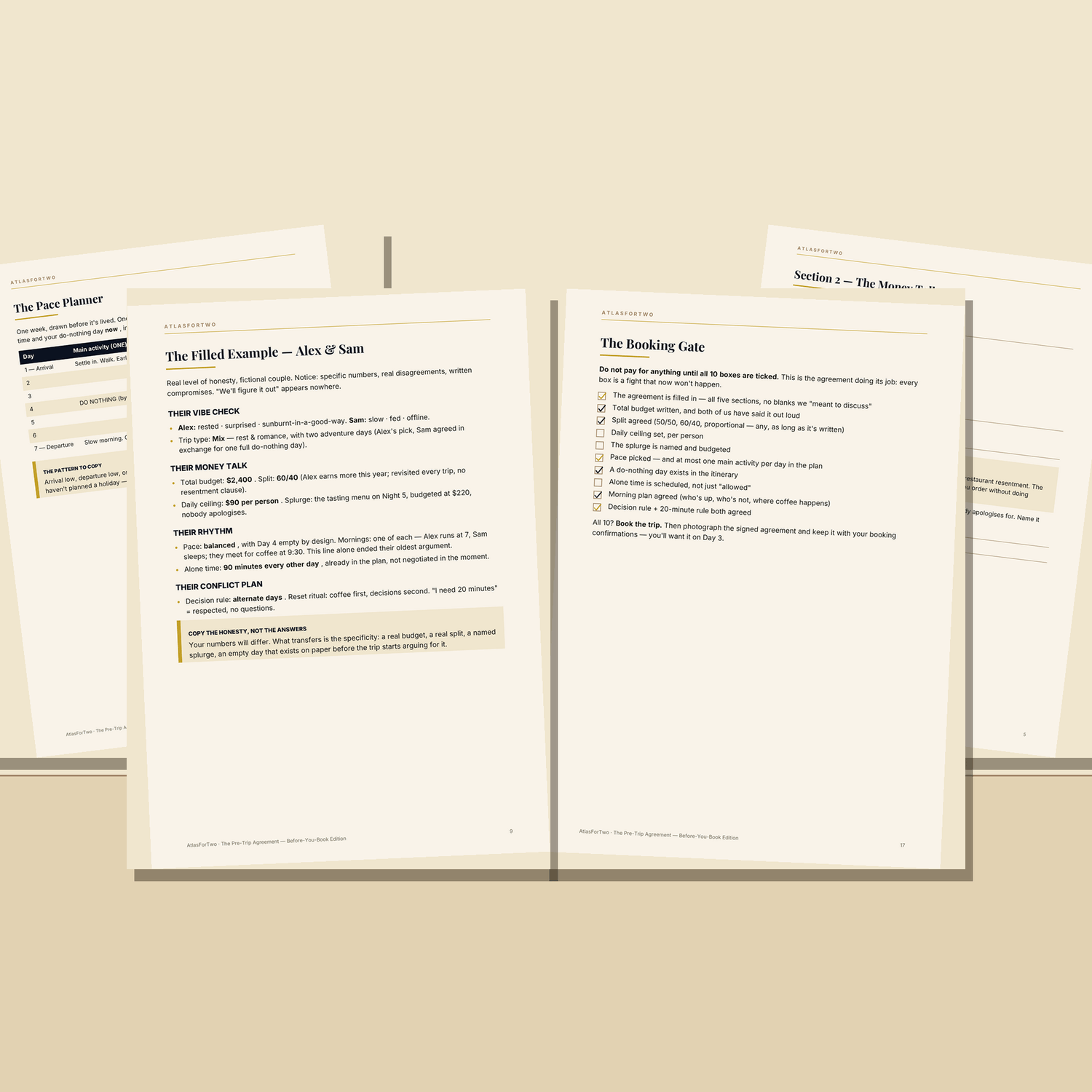
The Pace Planner, the filled example and the Booking Gate: if a box is unticked, you're not ready to book.
Questions couples ask us
Isn't this a bit… contractual? Are we killing the romance?
It's not legal, and it's not romantic in the candlelight sense — it's the most useful twenty minutes of the whole trip. Preparation isn't the opposite of spontaneity; it's what makes room for it.
What if our answers are completely different?
Then the conversation just paid for itself. On the small things, write the compromise — that's the exercise. On the big one — what this trip is even for — wildly different answers mean you need a different trip, not a compromise: different destination, different length, or two shorter trips that each get to be themselves.
When exactly should we do this — before or after booking?
Before any money moves. That's the entire design: every disagreement these 12 conversations surface is one that won't happen in another country, attached to reservations you can't change. If you've already booked, do it tonight anyway — most of the twelve still protect you.
It's our first trip together. Anything different?
Yes — shrink everything. Keep it short (four or five days is ideal; two weeks is a relationship marathon), choose easy logistics (direct flights, one base, no remote adventures), and take conversations 7 and 8 extra seriously: the early-bird/night-owl clash is the classic first-trip fight, and alone time matters from day one, even on a short trip. More on that side of the story in our companion piece: First Trip Together? The Mistakes Almost Every Couple Makes.
Want it done for you?
Everything above is free to do with a notebook and twenty honest minutes. If you'd rather have it as a fill-in tool — the five sections with room to write, the money and pace worksheets, word-for-word scripts for the five hardest sentences, and the Booking Gate checklist — that's exactly what our Pre-Trip Agreement for Couples is: print it, fill it in together, sign it, and only then book.
Agree first. Book second. Travel doesn't break relationships — bad planning does.
systeme.io
COMPARTE


One thoughtful email a week. No spam.
© AtlasForTwo • Privacy Policy • Terms of Service